TCF Canada vs. TEF Canada: Which Speaking Section is Easier?
By Feriel | Read time: 2 minutes
When comparing the TCF Canada and TEF Canada speaking sections, many students wonder which one is easier. To help you decide, let’s first break down the content of each test.
TCF Canada Speaking Section:
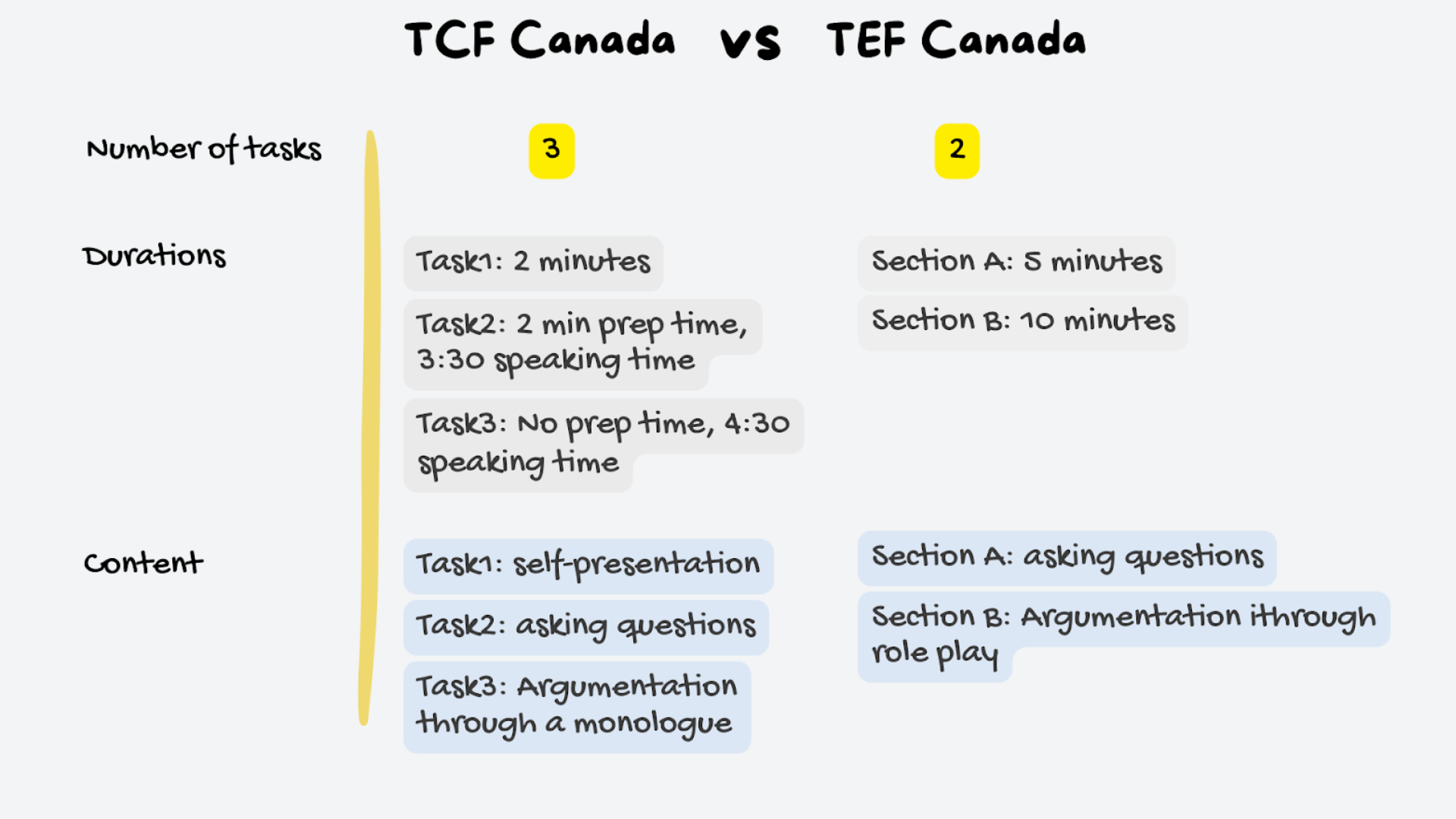
- Task 1: Present yourself. (Duration: 2 minutes)
- Task 2: Pose questions to obtain information. (Preparation: 2 minutes; Speaking: 3 minutes 30 seconds)
- Task 3: Give your opinion on a statement, including arguments. (Duration: 4 minutes 30 seconds; No preparation time)
TEF Canada Speaking Section:
- Section A: Ask about ten questions on a document/ad (no prep time, ~10 minutes).
- Section B: Argue/persuade in a simulated dialogue with a friend (~5 minutes).
Which is Easier?
The short answer is: it depends on your strengths and preferences. However, as a teacher, I’ve observed that the TCF Canada speaking section is easier for many students. Here’s why:
- Task 1 Can Be Fully Prepared in Advance
- The first task in the TCF Canada exam is straightforward: introduce yourself. Since this task can be practiced and memorized beforehand, it feels less intimidating for most students.
- Task 2 Is Shorter and Includes Preparation Time
- Compared to the TEF’s Section A, where you need to ask around ten questions without much guidance, the TCF Task 2 is more structured. Additionally, the two minutes of preparation time allow you to organize your thoughts.
- Task 3 Challenges Listening and Speaking Skills
- While Task 3 in the TCF can be a challenge—requiring a 4-minute 30-second monologue without preparation time—the common topics it covers make it manageable with practice. However, keep in mind that the question is given orally, so good listening skills are essential.
TEF Canada: A Matter of Preference
This doesn’t mean the TEF speaking section is inherently difficult. For some students, its interactive format may feel more natural. Here’s why:
- Section A: If you’re comfortable with spontaneous questioning, this section could play to your strengths.
- Section B: In this part, you engage in a dialogue to convince a friend. If you prefer interactive discussions and can think on your feet when responding to counter arguments, this might suit you better than delivering a monologue.
Final Thoughts
If your French proficiency is solid, the choice between TCF Canada and TEF Canada comes down to your personal strengths:
- Are you more comfortable preparing in advance and delivering a structured response? TCF Canada might be the better option.
- Do you thrive in interactive, conversational settings? TEF Canada could be the right fit.
Ultimately, both exams require preparation and familiarity with the test format. Focus on practicing common scenarios, improving your fluency, and building confidence in your speaking abilities—and you’ll be well on your way to success in either exam!
Preparing for the TCF Canada Speaking Section
If you're looking for step-by-step guidance to prepare for the speaking section of the TCF Canada exam, then check out my TCF Canada French Speaking Course here. It is designed with detailed lessons that cover every part of the speaking exam, helping you gain the skills and confidence you need to succeed. With my course, you’ll be ready to tackle every speaking task with ease, whether it's responding to simple questions or delivering a well-organized monologue.
Stay connected !
If you’d like to get a weekly dose of French tips, learning strategies, and updates on new
resources, you can join my newsletter 💌, BonjourBytes, below. 👇