Which Writing Section is Easier: TEF Canada or TCF Canada?
By Feriel | Read time: 3 minutes
If you're preparing for Canadian immigration, choosing between the TEF Canada and TCF Canada exams might be one of the most important decisions you'll make. Both assess your writing skills, but in very different ways. Understanding these differences is crucial to selecting the exam that best suits your needs. Let’s explore the differences:
TEF Canada Writing
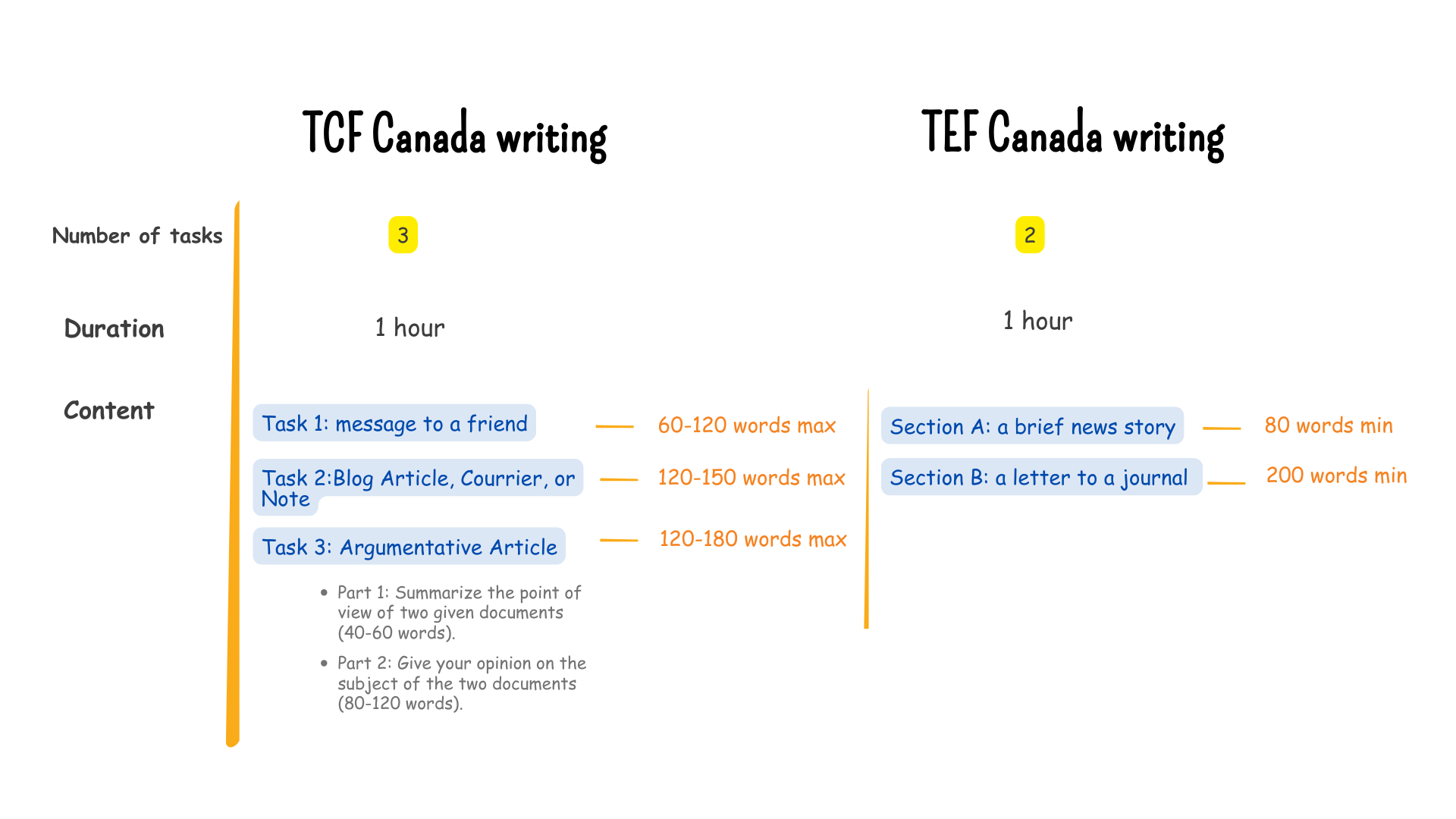
The TEF Canada Writing section includes two tasks, each with distinct requirements:
- Section A: Fait Divers
Length: 80 words
Task: Write a brief news-style report.
What is "fait divers"? A fait divers is a brief news item or story, often about everyday events or minor incidents. It’s commonly found in the miscellaneous or local news section of a newspaper. - Section B: Lettre au Journal
Length: Minimum 200 words
Task: Write a formal letter to a newspaper. This task requires you to present an argument, similar to the IELTS, where you must explain, provide examples, and develop your opinion effectively.
The TEF Writing section requires you to use a journalistic style. By learning specific tips and formats, you can perform well regardless of your current level. Focus on structuring your arguments clearly, providing explanations, and supporting your points with examples. Familiarity with common topics will also be helpful.
Note: The word limits given are minimum requirements, meaning you must write at least that number of words, but there is no maximum word limit.
If French is not your native language and you are still learning the language, I highly recommend keeping your writing relatively short to avoid making more mistakes. Writing more does not necessarily give you more marks; writing correctly and clearly is what matters most.
TCF Canada Writing
The TCF Canada Writing section consists of three tasks:
- Task 1: Message to a Friend (Email)
Length: 460-120 words (minimum and maximum)
Task: Write an informal message to a friend. - Task 2: Blog Article, Courrier, or Note
Length: 120-150 words (minimum and maximum)
Task: Share an experience, give an opinion, or make a proposal. - Task 3: Argumentative Article
Part 1: Summarize the point of view of two given documents (40-60 words, minimum and maximum)
Part 2: Give your opinion on the subject of the two documents (80-120 words, minimum and maximum)
Tasks 1 and 2 are relatively short and do not require an advanced level to achieve B2+. For the argumentative part in Task 3, the two texts provided give you a starting point, making it easier to come up with additional arguments or reformulate ideas. Learning the format for each section will greatly improve your performance.
Note: Unlike TEF where a minimum word count is required, here you have both a minimum and a maximum word limit. This can be helpful for time management because you do not need to write excessively long answers. Staying within the range allows you to save time while focusing on writing clearly and accurately.
Final Thoughts
Both exams are designed to evaluate your writing skills, but their content and requirements differ significantly. In my opinion, the TCF writing section is generally easier than the TEF writing section, mainly because TEF writing requires you to master specific genres, such as fait divers and lettre au journal. As a result, the learning curve is steeper for TEF compared to TCF, where the tasks usually involve writing simple messages similar to those encountered in everyday life. To illustrate the difference: even a native speaker would likely need specific preparation to structure a fait divers correctly for the TEF, whereas they could likely navigate the TCF tasks with little to no prior training.
To determine which exam best suits your profile, I recommend practicing both sections under strictly timed conditions without external resources. Afterward, compare your performance, seek professional feedback, and identify which structure aligns more naturally with your existing strengths.
Stay connected !
If you’d like to get a weekly dose of French tips, learning strategies, and updates on new
resources, you can join my newsletter 💌, BonjourBytes, below. 👇